
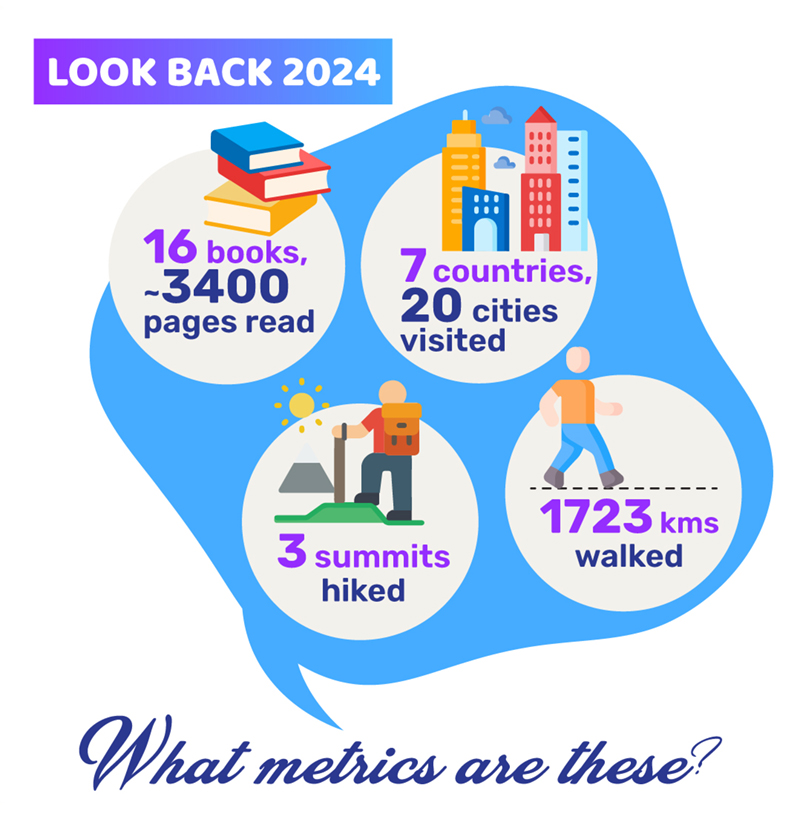
📚🌍🚶♂️ A friend recently shared his “2024 in numbers”:
* 16 books, ~3400 pages read
* 7 countries, 20 cities visited
* 1723 km walked
* 3 summits hiked
Impressive, isn’t it?
But being a product manager, I couldn’t stop myself from asking him – “Fantastic. But these are input metrics, where are the output metrics?”.
“Did these lead to greater happiness, better health, stronger relationships, deeper perspectives or just great memories?”
While it is difficult (and sometimes awkward) to measure something as abstract as ‘happiness’, I felt they are very important in a look back. These could help figure out true priorities, decide the next milestones, and make course corrections if required.
It is true that when it comes to action/plan, input metrics are very important and the key to moving forward. But a look back should start with output metrics.
Being a product manager and asking these questions is a definitive way to lose friends 😄.
Jokes aside, even product managers fall into the same trap: celebrating the effort (inputs) without reflecting on the impact (outcomes). Happens with executive pet projects, vanity features, or cool-only tech initiatives.
It’s great to ship features, run sprints, and meet deadlines, but the real measure of success is whether your product makes users’ lives better, solves their problems, or drives meaningful results—at least in the long run.
So, keep asking the tough question: What impact are we truly creating, and for whom?
What examples in product management or life have you seen where there is a misplaced focus only on input metrics? I am curious to know.
